
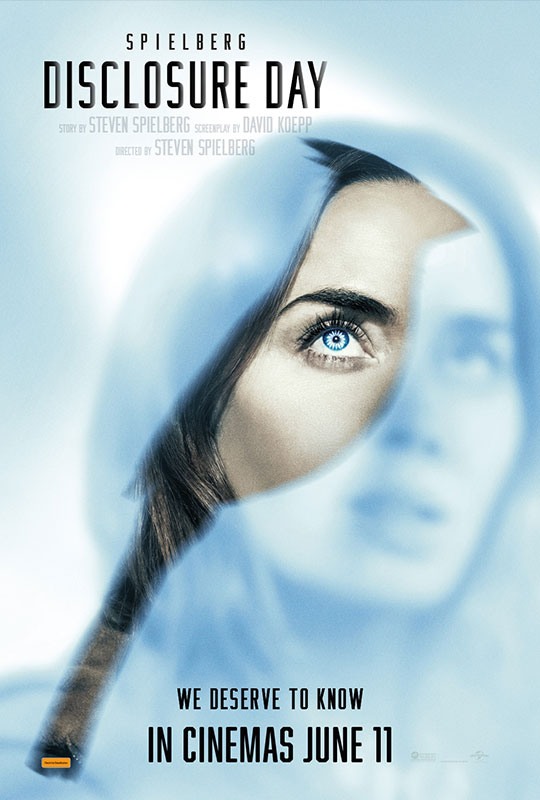
Disclosure Day was by far my most anticipated movie of the year — Steven Spielberg’s long awaited return to the UFO subject.
Callum Berry.
Mild Spoilers Review.
If you’ve been a long-time listener of the Tuesday Review, you’ll know that the UFO/UAP arena is something that we’ve had a keen interest in over the years, as has Spielberg (see his classics Close Encounters of the Third Kind and E.T. The Extra Terrestrial).
Steven returns to the field by giving us a fairly sweeping sci-fi thriller in which Emily Blunt’s ‘Margaret Fairchild’ begins to develop mysterious psychological symptoms in which she believes she can read minds and know things, and she finds herself being pulled in a certain direction, towards a certain person whom she has never met — Josh O’Connor’s ‘Daniel Kellner’, who is an on-the-run cyber-expert for what is essentially an unacknowledged SAP, ‘Wardex Corporation’. Kellner must deliver the data to a certain place at a certain time.
Kellner has stolen sensitive information from Wardex and is being hunted by the head of the organisation, Colin Firth’s ‘Noah Scanlon’. Scanlon is the keeper-of-the-keys; a kind of ‘Smoking Man‘ who is a center of all-things UAP. Scanlon’s motivations in stopping Kellner are clear: if the sensitive data is released, it could cause a global catastrophe the likes of which we have never seen.
What ensues is a standard chase-thriller with some science-fiction dressing, which at times feels like it could have come out the nineties or 2000’s — when it works it is great, and when it doesn’t it very much falls flat on its face, sucking the wind out of the sequence.
Disclosure Day‘s screenplay was penned by the prolific David Koepp, who if I’m being honest, doesn’t always bang out a hit screenplay, but has under his belt some absolute gems such as Death Becomes Her, Mission: Impossible, Panic Room, and Black Bag just to name a few.
Koepp’s screenplay for Disclosure Day relies on movement and momentum, as some of the best thriller screenplays do (The Fugitive, Marathon Man etc), and as mentioned above, this takes the form of the chase sequence. The movie begins with Kellner running from the black unmarked cars of Wardex (drones aren’t a thing in this universe) and their agents, all of whom seem to have broad impunity to do as they like even though they’re not technically government agents (again, a very nineties concept).
Kellner’s problem is that the screenplay is stuck in the nineties, and as such he cannot just upload the files to a secure cloud-server, or a friendly agent, and dump the loot, he must carry it by-hand to the third-act of the film, Scanlon is likewise stymied by this strange technological hindrance imposed by Koepp’s screenplay; a company with presumably infinite resources doesn’t take any real advantage of their palantir-style systems.
From a directorial perspective, Spielberg lays out all the hits: the classic tracking/long-takes that we all love, the beautiful and emotive John Williams score, and the Spielberg-cheese (both the good and the bad kind). Spielberg’s presence isn’t felt all the way through this film (which sits at two and a half hours), but when I felt him, I felt him; there’s a great scene in which Kellner is fleeing some goons with Eve Hewson’s ‘Jane Blankenship’ in the backseat, which makes use of reflective surfaces such as a blade and car mirrors which was spectacular to watch and reminded me that a master was at-work, but then the moment is over and Disclosure Day becomes an almost-generic sci-fi flick for another half-hour before we’re graced with another Spielberg moment.
Spielberg is still among the best living directors, his last release, The Fabelmans, was one of the best movies of the last 10 years, but I feel his natural talent was being repressed by an underwhelming screenplay, the chase-sequences had little tension and didn’t look particularly great, with one sequence involving cars and a train looking quite awful on-screen, and when you’re focusing on how rough a scene looks you’re not investing yourself in the story or the characters. The same can be said for the awful CGI, which some have defended as looking uncanny on-purpose, but that’s something I reject — there’s never an excuse for bad CGI when you have a great budget and resources.
The performances delivered by the ensemble cast is uniformly great, with Emily Blunt and Colin Firth delivering outstanding efforts (Colin Firth delivers a career-high performance). Blunt and Firth’s characters give them the most to work with, with Blunt having to tap-in to a psychotic/surreal experience and Firth having to straddle the line between ego and pseudo-patriotism and finding in him an aggressive performance I haven’t really seen from him before.
For the sake of avoiding spoilers I won’t go into the details of the science-fiction tropes used, but it was nice to see some legitimately ‘weird’ and ‘woo’ UAP references being integral to the screenplay — Koepp and Spielberg had an idea of what they were doing, the screenplay just couldn’t articulate their story well-enough for it to be worth the budget.
The climax of the movie leaves us with a cliff-hanger that cuts the legs out from under the entire movie. I didn’t hate Disclosure Day, but I can’t say I loved it, I don’t even know if I liked it. It’s an important movie for those us in interested in the UAP field, and as an ‘artifact’ of this niche culture it’s great, but as a film it doesn’t really work.
It’s complicated/5.
Callum Berry.
-
A Place Without Fear (2023) – Susanne Deeken
Callum Berry. A Place Without Fear is only a short film, around thirty minutes, but what an uncomfortable thirty minutes it is. Deeken combines photography, painting, and textures to create a haunting…
-

Chaosium Returns to PAX!
Callum Berry. Chaosium Returns to PAX Australia: A Treasure Trove of TTRPG Adventures The Tuesday Review’s favourite creator returns once again to Australia’s biggest gaming convention! If you’re a fan of TTRPGs…
-
The Staircase (2022) – Antonio Campos
The Staircase is a dramatisation of a documentary series of the same name, in which we see Callum Berry. Mild Spoilers. Colin Firth stepping up to take on the roll of Michael…

Leave a Reply